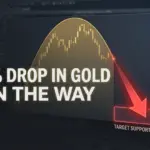
Gold Price Forecast March 11, 2026 – $60 Drop Then $170 Rally?
Gold remains in focus as traders assess whether the current pullback is simply a pause within a broader uptrend or the start of a deeper retracement. The outlook for March 11, 2026 centers on a two-stage possibility: an initial decline of roughly $60 followed by a potential bullish expansion of about $170. While that framing is directional rather than definitive, it highlights the market’s current tension between short-term weakness and larger bullish structure.
The analysis is built around market structure, liquidity zones, and supply and demand dynamics. In practical terms, that suggests traders are watching how price behaves around areas where orders may be concentrated. If gold continues to trade lower into support and attracts strong buying pressure, the bearish leg could be treated as a corrective move rather than a trend reversal. In that case, a recovery phase could develop into a stronger upside expansion.
At the same time, the downside scenario remains relevant. If the recent correction fails to stabilize and price continues through lower support areas, that would strengthen the case for bearish continuation in the short term. This is an important distinction because a correction inside a bullish trend often looks similar at first to the early stages of a broader decline. The difference usually comes from confirmation: whether buyers regain control through structural shifts, or whether sellers maintain pressure and force price into lower zones.
A key takeaway is that the market is being viewed through multiple scenarios rather than a single fixed forecast. That is the more disciplined way to approach a volatile instrument like gold. One path involves further weakness before a meaningful rebound. Another involves a deeper retracement that delays or invalidates the bullish expansion idea. The deciding factors are likely to be reaction quality at demand areas, the presence or absence of strong buying pressure, and whether short-term structure begins to turn upward again.
For intraday and short-term traders, this kind of setup usually requires patience. A projected downside move followed by a larger rally can be attractive on paper, but it is only actionable if the market provides confirmation. That means waiting for evidence that selling is exhausting, that buyers are defending key zones, and that price structure is shifting in favor of continuation higher. Without that confirmation, trying to anticipate the turn too early can expose traders to unnecessary risk.
Risk management is clearly central to this outlook. In an environment where both bearish continuation and bullish reversal are plausible, position sizing and trade selection matter as much as directional bias. Traders should be especially careful when volatility expands around major technical zones, since false breaks and sharp reversals are common in gold. A scenario-based plan, with predefined invalidation and disciplined exposure, is more useful than relying on conviction alone.
The broader message is balanced: gold may still have room to dip before any stronger upside phase emerges, but the larger bullish case has not necessarily been ruled out. The market appears to be at a decision point where structure and order-flow behavior will matter more than broad assumptions. Until price confirms one path, flexibility remains the most valuable edge.
This remains an educational market view, not investment advice. Traders should do their own analysis and apply proper risk controls before making decisions.