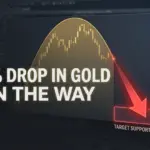
Correct ✅ Don’t Fall for Gold’s Trap Tomorrow | $5,000 Support – Feb 22, 2026
Gold Near $5,000 Support: Why Traders Should Avoid the Trap
Gold is sitting at a technically important area, with the market testing the $5,000 support zone amid elevated volatility and sharp intraday reactions. The current setup appears to be less about making bold predictions and more about reading market structure carefully. In conditions like these, traders are often exposed to false breaks, emotional positioning, and liquidity-driven moves that can punish both early buyers and aggressive sellers.
The central question is whether gold is stabilizing above support or setting up for a liquidity sweep before another leg lower. That distinction matters. If price is being accumulated above $5,000, the market may be building a base for a corrective rebound toward overhead resistance. If instead the support gives way with confirmation, the structure would shift toward a deeper retracement scenario.
From a technical perspective, the emphasis is on supply and demand zones, momentum changes, and transitions in market structure. In a volatile environment, support alone is rarely enough. Traders typically need to see how price behaves around that level: whether reactions are impulsive or weak, whether buyers can defend the zone consistently, and whether downside probes are rejected or accepted. These are the kinds of clues that help separate genuine support from a temporary pause before continuation lower.
The broader macro backdrop is also part of the picture. While no specific macro catalyst is identified here, the implication is clear: gold is not trading in isolation. Broader conditions can amplify intraday volatility and distort short-term signals, making confirmation even more important. That is especially true when a round-number level such as $5,000 becomes a focal point for liquidity and trader attention.
For bullish traders, the constructive scenario is straightforward in principle: gold holds above $5,000, demand remains visible, and momentum begins to improve. In that case, a corrective rally toward higher resistance levels becomes more plausible. However, the word corrective is important. A rebound from support does not automatically mean a full trend reversal; it may simply be a recovery within a more complex structure.
For bearish traders, the key is not just a dip below support, but a confirmed breakdown. In many volatile markets, initial breaks can be engineered or exaggerated by liquidity dynamics before price snaps back. That is why chasing the first move can be dangerous. A true bearish continuation would require evidence that the market has accepted trading below the support area and is transitioning into a weaker structure.
The practical takeaway is that this is a market where patience may offer more value than prediction. Liquidity pools, order flow, and structure shifts are especially relevant when price is compressed around a major level. Traders who wait for confirmation signals are generally better positioned than those reacting emotionally to intraday spikes.
Risk management remains the most important part of the setup. In a market defined by sharp reactions, position sizing and disciplined trade planning matter as much as directional bias. Whether one is looking for a bounce or a breakdown, the environment calls for controlled exposure and a willingness to step aside if the signal is unclear.
Gold at $5,000 is therefore less a certainty than a decision point. If support holds, a corrective recovery may develop. If it fails convincingly, deeper retracement risk increases. Until the market shows its hand more clearly, avoiding the trap likely means respecting volatility, demanding confirmation, and keeping risk tightly managed.