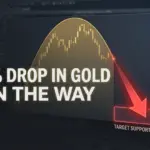
Correct ✅ Is the Next Gold Drop Near? February 24 Market Analysis
Gold remains at a technically sensitive point, with the latest February 24 market analysis centered on a straightforward question: is the next meaningful downside move getting close?
The core takeaway is not a fixed prediction, but a structured assessment of probability. The analysis focuses on current market structure in gold, highlighting the importance of resistance and support zones, liquidity areas, and recent price behavior in judging whether XAU/USD is preparing for bearish continuation or simply undergoing a corrective pullback before the next move develops.
A key theme is the distinction between continuation and correction. In practical terms, that means traders should avoid assuming weakness automatically leads to a larger selloff. Instead, the market must show confirmation through structure shifts, momentum behavior, and order flow. This keeps the framework disciplined and prevents overreacting to short-term volatility.
Momentum and order flow appear central to the short-term and mid-term outlook. When these align with a weakening structure, the bearish case becomes more credible. If they fail to confirm downside pressure, however, gold may remain in a corrective phase rather than entering a broader decline. That makes confirmation signals especially important in the current environment.
Macro-driven sentiment is also part of the picture. While no single macro catalyst is specified, the analysis suggests that broader sentiment is influencing how traders interpret price action. For gold, this matters because technical levels often become more meaningful when they align with shifts in risk appetite, defensive positioning, or broader market expectations.
Another useful aspect of the analysis is its emphasis on scenario mapping. Rather than treating the market as a one-directional bet, traders are encouraged to prepare for multiple paths. One scenario supports bearish continuation if structure and momentum confirm weakness. Another allows for a corrective move if support holds and downside follow-through fails to develop. This approach is especially relevant in volatile conditions, where gold can move sharply in both directions before revealing its true intent.
Risk management is presented as a central part of the process, not an afterthought. The discussion includes invalidation levels, risk-to-reward positioning, and the need to adapt if the market shifts from distribution to expansion. That is an important distinction. A market that appears heavy can still transition into a stronger directional phase if the underlying structure changes. Traders who define invalidation clearly are better positioned to respond objectively instead of becoming anchored to a single bias.
The broader lesson is that gold analysis is most effective when it is built on structured decision-making rather than prediction. In a market like XAU/USD, where volatility can quickly distort sentiment, the ability to read structure, wait for confirmation, and manage risk consistently often matters more than trying to call the exact next move in advance.
For traders watching gold here, the message is clear: focus on how price behaves around key support, resistance, and liquidity zones; monitor whether momentum and order flow confirm weakness; and remain flexible enough to adjust if the market moves from a distribution phase into expansion. The next drop may be near, but only confirmed price behavior can validate that view.