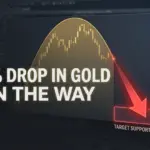
Don’t Be Deceived! Major Gold Crash Ahead
Gold may be entering a more fragile phase, with the latest market commentary centered on a clear warning: traders should not assume the uptrend remains secure simply because the broader metal has been strong in the past. The core message is that signs of weakness are beginning to appear, and a deeper corrective move is now a realistic scenario rather than a remote possibility.
The analysis points to a deterioration in market structure, especially through weakening bullish momentum and evidence of distribution near important resistance areas. In practical terms, that suggests buying pressure may be losing force while sellers become more active at higher levels. When that combination develops near resistance, it often raises the risk of a reversal or a sharper pullback.
A key part of the bearish case appears to be the behavior of price across higher timeframes. That matters because higher-timeframe structure tends to carry more weight than short-term fluctuations. If broader charts begin to show failed continuation, rejection near resistance, or unstable support behavior, traders often interpret that as a warning that the market is vulnerable to a larger correction.
The discussion also emphasizes liquidity sweeps and potential breakdown zones. This suggests the market may be moving in a way that traps participants on one side before reversing, a common feature in volatile environments. If support areas fail after such behavior, downside momentum can accelerate as stops are triggered and positioning unwinds.
At the same time, the outlook is not presented as one-dimensional. Alongside the bearish continuation scenario, there is also an alternative bullish defense case if key support levels hold. That is an important distinction. It means the market is at a decision point rather than in a confirmed collapse. A successful defense of support could stabilize sentiment and delay or invalidate the more aggressive bearish thesis.
Volatility expansion, order flow, and risk-to-reward positioning are highlighted as especially important in current conditions. That framing suggests traders should be cautious about chasing moves without confirmation. In a market that may be transitioning from strength to instability, entries become more sensitive, and poor positioning can be punished quickly.
The broader takeaway is less about predicting an inevitable crash and more about recognizing that gold may be losing technical strength at a critical area. For traders and investors, the practical response is discipline: wait for confirmation, respect support and resistance behavior, and avoid oversized exposure in a market showing signs of possible downside pressure.
Risk management stands out as the most actionable theme. Proper position sizing, clear invalidation points, and patience around confirmation signals are essential when both bearish and bullish scenarios remain in play. In an environment like this, preserving capital can be just as important as identifying the next directional move.
Overall, the warning is that gold may be approaching a meaningful test. If weakness in momentum and distribution near resistance continue, the probability of a deeper correction rises. If support holds, however, the market could still defend itself. Until that battle is resolved, caution appears to be the most sensible stance.